Should You Use AI to Answer Customer Enquiries?
When it helps, when it damages trust, and how to tell which situation you are in before you switch anything on.
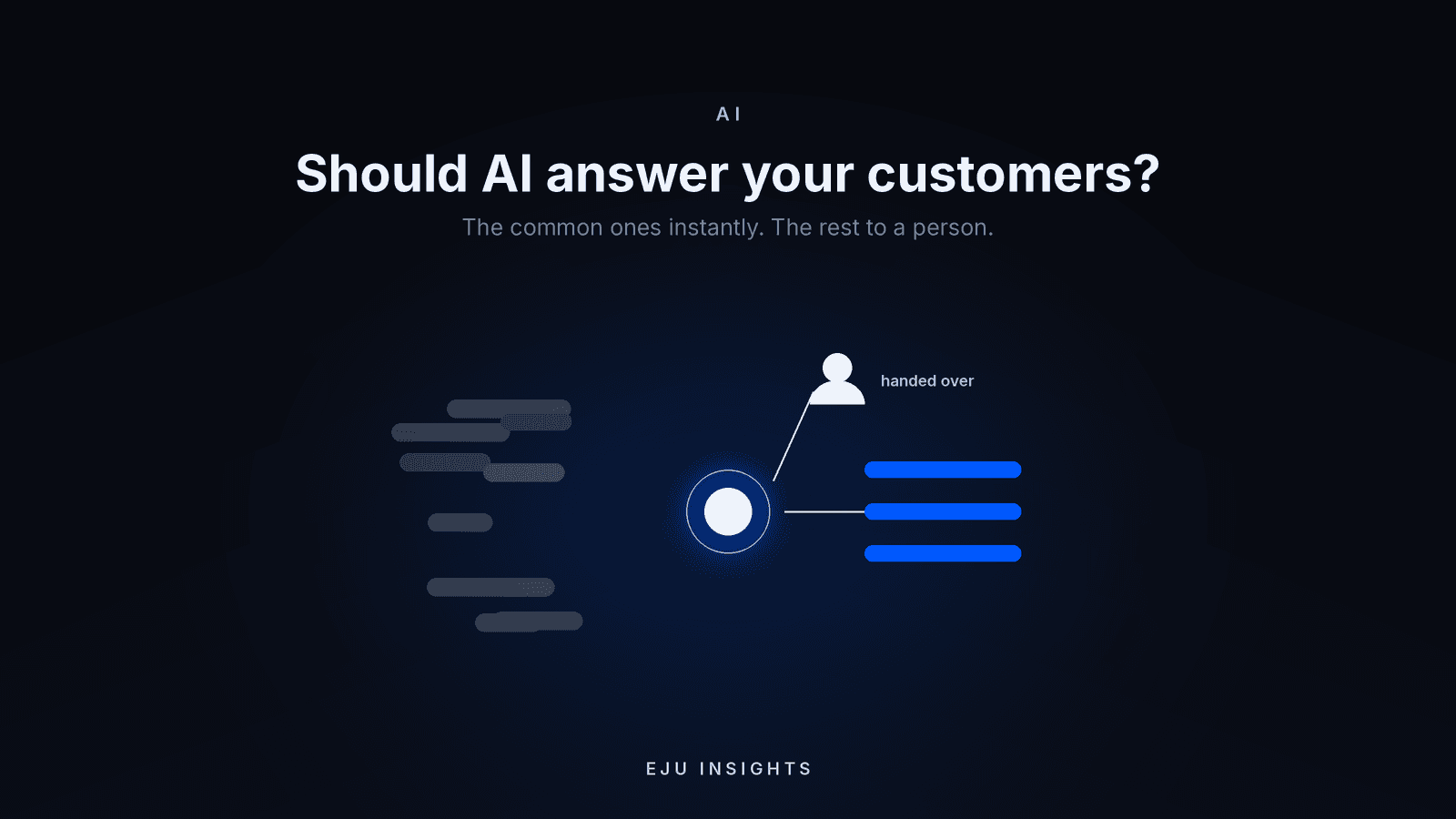
AI is worth using for customer enquiries when most of your questions are repetitive and factual. It answers the common ones instantly, at any hour, and hands the unusual ones to a person before the customer notices anything is wrong.
The decision is not really about AI. It is about the shape of your inbox. Two companies with identical volumes can get opposite results, because one gets the same twelve questions all day and the other gets twelve hundred different ones.
So the useful question is narrower than the one people ask. Not "should we use AI for customer service", but "which of our questions should it be allowed to answer, and what happens the moment it cannot".
When does AI genuinely help?
When the same questions repeat. Opening hours, prices, delivery areas, order status, what to bring, how to reschedule, whether you serve a location. These have documented answers and no judgement is involved.
When volume is high enough to hurt. If enquiries pull staff away from paying work, or replies routinely take a day, the arithmetic changes fast. The cost of a support team scales with volume. The cost of answering a documented question does not.
Outside working hours. Most enquiries arrive when people are free, which is often when your team is not. An instant, correct answer at nine at night is worth more than a considered one at ten the next morning.
Across languages. If customers write in several languages, AI removes a staffing problem that used to be solved by hiring or by making people wait. This is one of the clearest wins available.
Across branches or locations. Every branch fields the same questions. One assistant, one set of facts, answers that do not vary by whoever picked up the phone.
For simple technical guidance. Reset instructions, setup steps, how to find something in an account. Documented, checkable, and easy to verify.
When does it hurt?
Complaints and anything emotional. A customer who is angry, disappointed, or worried needs a person immediately. An automated reply in that moment reads as a company avoiding them.
Anything involving money leaving your side. Refunds, credits, compensation, cancellations with charges. Let AI collect the details and prepare the case, then let a person decide.
High value or complex sales. If the enquiry is worth a lot, the reply is a sales conversation, not a lookup.
Regulated advice. Health, legal, financial, insurance. The rules exist for good reasons and a confident wrong answer creates liability.
When your own information is scattered or out of date. This is the most common failure and the least discussed. If prices live in three places and two of them are wrong, an assistant will quote the wrong one instantly, to everyone.
What has to be in place before you switch it on?
One source of truth. A single documented set of facts: prices, policies, hours, coverage, procedures. The assistant answers from that and nothing else. If you cannot produce that document, that is the first project, not the AI.
A real escalation path. A clear route to a person, triggered by frustration, by a second failed attempt, by any of the categories above, and by the customer simply asking. An assistant that cannot hand over is worse than no assistant at all.
Honesty about what it is. Tell customers they are talking to an automated assistant. People forgive a bot that says it is a bot. They do not forgive discovering it after ten minutes.
Limits on what it may say. No inventing policy, no estimating dates, no promising anything not in the source document. Where it does not know, it should say so and pass the enquiry on.
Logging and a weekly review. Every conversation stored, read weekly at first. The questions it failed on are the most valuable list your business will produce this quarter.
How do you decide, using your own data?
Take your last hundred enquiries and sort them into three piles.
Pile one, repetitive and factual. Answerable from documented information.
Pile two, account specific. Needs a lookup into an order, booking, or record, but still has a right answer.
Pile three, judgement or emotion. Complaints, negotiations, unusual requests, anything sensitive.
If pile one is more than half, AI will pay for itself quickly. If pile two is large, it will pay once it is connected to your systems, which is a bigger build. If pile three dominates, do not automate the answering. Use AI behind the scenes to summarize and draft for your team instead, and keep humans in front.
That exercise takes an afternoon and it is more reliable than any vendor demonstration.
How do you roll it out without damaging trust?
Start on the lowest stakes channel, usually the website, not your main phone line or WhatsApp. Cover only the questions from pile one. Keep the escalation aggressive at first, meaning it hands over quickly and often.
Run it beside your team for two weeks without telling it to be clever. Read every conversation. Then widen its scope one question type at a time, based on what the logs show it handles cleanly.
The instinct to launch with everything switched on is the single most expensive mistake in this category.
What does success look like after ninety days?
Four numbers, measured before and after.
How many enquiries were fully resolved without a person. How many escalated, and how quickly. First response time across all channels. And the correction rate, meaning how often a human had to fix something the assistant said.
A healthy pattern is a high resolution rate on pile one, a fast and clean escalation on everything else, and a correction rate near zero. If the correction rate is rising, narrow the scope rather than adding more instructions.
Mistakes worth avoiding
Launching without an escalation route. Letting it answer questions your own documentation does not cover. Hiding that it is automated. Measuring only deflection, which rewards a bot for refusing to help. And leaving it unread, so nobody notices it has been giving a wrong delivery estimate for six weeks.
The quieter point
Good automated support is not about removing people from customer service. It is about removing the questions that never needed a person, so your team can spend their attention on the ones that do.
Get the next one by email
Reporting, reviews, and guides on AI and automation, sent as they publish. No sequences.