How Much Does It Cost to Add AI to Your Business?
The real price bands, the running costs, and how to tell whether the spend will pay for itself.
The cost of AI for business depends on one thing above all others: how much of your data and workflow the AI has to understand. A narrow, well scoped use runs from a few dollars a month to a few thousand to build, while a broad one that touches every system you own runs into tens of thousands.
That explains most of the confusion in the market. One owner is quoted 40 dollars a month and another is quoted 45,000 dollars, and both quotes can be honest, because they are not buying the same thing. This guide breaks the AI automation cost into the three bills you will actually receive, shows the arithmetic, and sets out how to judge whether the spend pays.
What are you actually paying for?
Every AI project has three cost lines, and mixing them up is where budgets go wrong.
The running cost. What the AI charges to think, billed by usage, and almost always the smallest number on the page.
The license cost. What you pay per person for ready made tools like Copilot or ChatGPT for business. Predictable, and charged whether the seat gets used or not.
The build cost. Connecting AI to your data, your systems, and your rules, then testing it until it is reliable enough to trust. This is the number that varies by a factor of fifty.
What does AI cost to run?
Less than most owners expect. Models are billed per million tokens, and a token is about three quarters of a word. Published rates for the main OpenAI tiers currently run from 5 dollars per million input tokens on the flagship to 2 dollars on the balanced tier and 20 cents on the cheapest current generation tier, with output priced around six times higher.
In practice: reading, classifying, and summarizing 3,000 customer emails a month, at roughly 1,500 tokens in and 200 out each, is about 4.5 million input tokens and 600,000 output tokens. On the balanced tier that is roughly 16 dollars a month. On the cheapest current tier it is under 2 dollars.
The lesson is not that AI is cheap. It is that the thinking is cheap and the plumbing is not. When a vendor quotes you thousands per month for a small workload, ask what portion is model usage and what portion is their margin.
What does it cost to buy versus build?
Three bands cover almost every small and mid sized business.
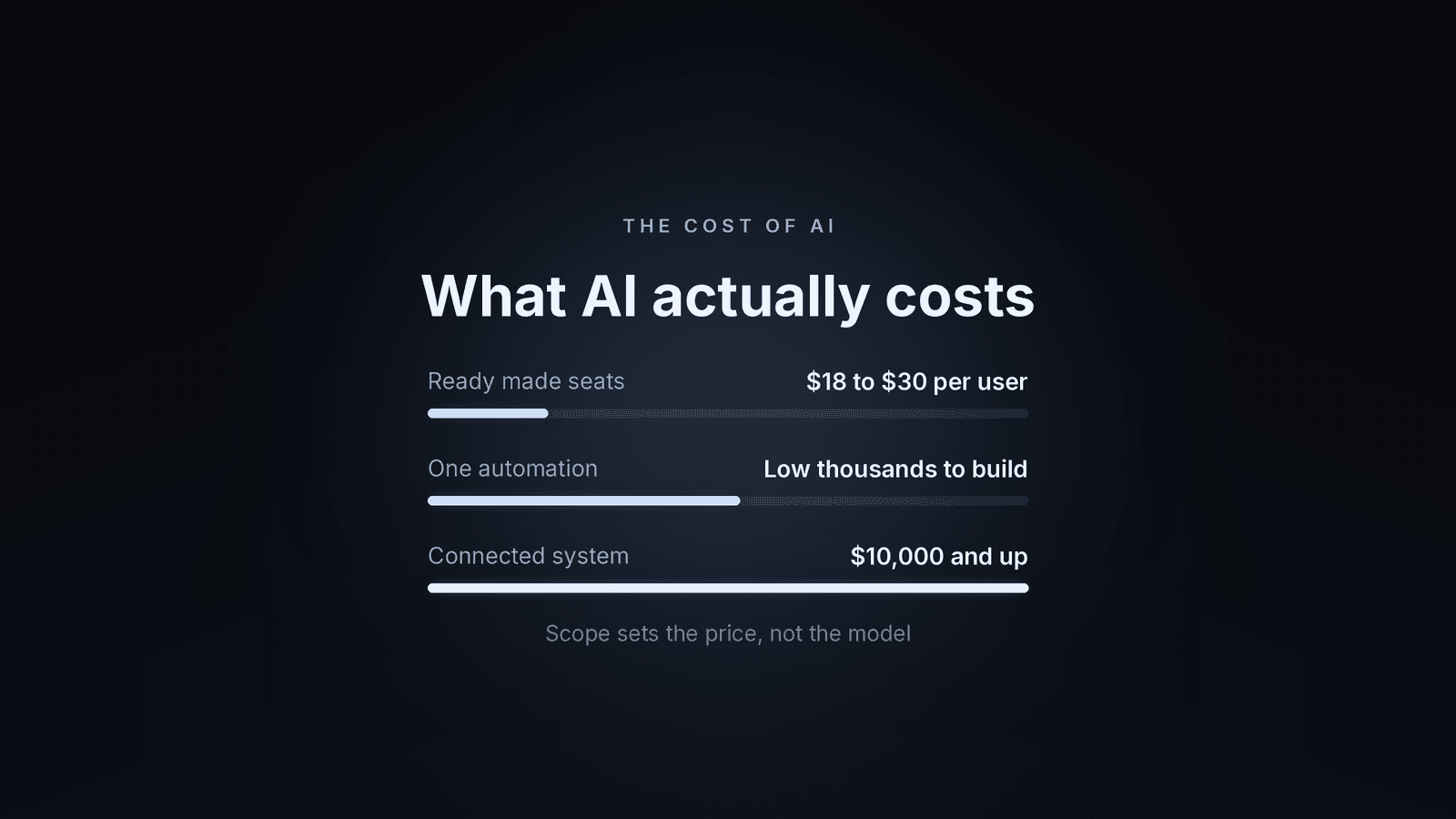
Band one, ready made seats. Roughly 18 to 30 dollars per user per month for business tiers of the mainstream assistants, nearer 60 for enterprise plans. Setup is near zero, but these tools know your documents, not your operation. They will not update your CRM, send an invoice, or follow your rules.
Band two, one narrow automation. A single well defined job connected to one or two systems: enquiries classified and routed, quotes drafted from a form, documents read and written into your database. Build cost is usually in the low thousands, running at roughly 20 to 150 dollars a month. This band produces the best returns we see.
Band three, a connected system. AI working across several tools, with retrieval over your own knowledge base, approvals, audit logs, and error handling. Build cost starts around ten thousand and climbs, running at a few hundred dollars a month. Justifiable when the process it replaces costs you a full salary or more.
The jump between bands is not caused by cleverer AI. It is caused by scope, because each extra system, exception, and approval multiplies the work of making the thing reliable.
Why does scope drive the price so much?
Five things move the number, and none of them are the model itself.
How many systems it touches. One integration is a project. Five is five projects plus the connections between them.
How much of your data it must read. Answering from a single form is trivial. Answering correctly from twelve years of files, half of them scanned, is a data project before it is an AI project.
How exact it must be. Going from 90 percent to 99 percent correct often costs more than everything before it, because that stretch is all testing, edge cases, and guardrails.
Whether a human reviews the output. A system that suggests is cheap. A system that acts alone has to be built to fail safely, and that costs more.
What costs do people forget?
Data cleanup, which is regularly the largest line in phase one. If your information is scattered across inboxes, spreadsheets, and one person's memory, that gets fixed before AI can use it.
Testing. Ordinary software either works or throws an error, while AI output can be plausible and wrong, so it has to be measured against real examples before launch.
The supervised period, meaning a few weeks where a human checks the output. Skipping it is how businesses find problems through customer complaints instead.
Maintenance. Models get retired, processes change, instructions drift. Expect a modest ongoing cost, as you would for a website.
How do you know whether it will pay for itself?
Compare what the task costs you now against what it will cost afterwards.
Count the hours it consumes each month, multiply by the loaded hourly cost of whoever does it, and add a realistic figure for what the mistakes cost. That is your current bill. If build cost divided by monthly saving pays back inside about six months, it is usually worth doing. Past twelve months, the scope is probably too broad.
A worked example. A team spends 20 hours a month preparing quotes at 25 dollars an hour, which is 500 dollars, plus a few deals lost to slow replies. A band two build in the low thousands, running at 40 dollars a month, pays back in under a year on labor alone and much faster once the lost deals count.
If you cannot fill in those numbers, that is your finding. Do not buy AI to fix a process you have not measured.
Can a small business afford AI?
Yes, and the entry point is lower than the noise suggests. Start with seats for the people doing the most repetitive knowledge work, measure what changes over a month, then spend build money on the single task with the clearest arithmetic.
What a small business cannot afford is a broad AI initiative with no defined outcome. That is where budgets go quietly and nothing measurable comes back.
The quieter point
AI is not a product you buy. It is a capability you point at a specific job, and the businesses getting real value are rarely the ones spending the most. They picked one expensive, repetitive task, scoped it tightly, and let the system take it over completely.
Get the next one by email
Reporting, reviews, and guides on AI and automation, sent as they publish. No sequences.