What Can AI Actually Do for Your Business Right Now?
A grounded look at the jobs AI handles reliably today, the ones it does not, and how to tell which is which.

Today AI reliably handles a few real jobs inside a business: answering the questions customers ask constantly, drafting and summarizing text, sorting and routing incoming messages, and pulling data out of documents. Those four are dependable enough to put into daily use, provided a person still reviews anything that goes out with your name on it.
That list is deliberately short. Everything else you have been told falls into two piles: things that work with supervision, and things being sold ahead of what they can do. The gap between those piles is where budgets get wasted, so this article draws the line as honestly as we can.
None of this depends on how big you are. A two person studio and a sixty person operation use the same four capabilities. What changes with size is the volume of the work being removed and how much process has to be written down first.
What does AI do reliably today?
Answering questions you get every day. Opening hours, prices, coverage areas, policy questions, how to reschedule, where an order is. The questions repeat, the answers are known, and the value shows up in the first week. It works when the assistant is given your real information and a clear route to a human for anything outside the script.
Drafting and summarizing. First drafts of replies, quotes, proposals, descriptions, and internal updates. Summaries of long threads, meeting notes, contracts, and reports. AI gets to roughly eighty percent of a piece of writing in seconds, which is exactly the part that takes people longest.
Sorting and routing what comes in. Reading every new message, enquiry, ticket, or application, working out what it concerns, how urgent it is, and who should handle it. This is quiet and unglamorous and it is probably the highest return use available today, because it removes decisions rather than typing.
Reading documents and extracting the data. Invoices, receipts, delivery notes, purchase orders, forms, identity documents, applications. Pulling out the fields and writing them into your systems instead of a person retyping them. Document work has become one of the fastest growing uses of AI in business, for good reason: the inputs are messy, the output is structured, and the saving is obvious.
Two more are dependable and worth knowing: transcribing calls and meetings into searchable notes, and translation good enough for customer correspondence.
What does it still get wrong?
It does not know your business. It knows language. Your prices, policies, stock, contracts, and exceptions have to be supplied, structured, and kept current. Most disappointing results trace back to this rather than to the model.
It states wrong things confidently. Ordinary software either works or throws an error. AI produces something plausible either way, which is why anything customer facing needs review until you have measured it against real cases.
It should not act alone where mistakes are expensive. Sending money, making commitments, changing prices, cancelling bookings, replying to a complaint. Let it suggest, and let a person approve. That is not timidity, it is how you keep the upside without the tail risk.
An assistant with no escape route is worse than none. A system that cannot answer a specific question and cannot pass the customer to a human damages the relationship more than silence would. Escalation is part of the minimum, not a later addition.
Agents working across messy systems are still early. They demo beautifully. In a real company with half migrated data and three tools that disagree about the same customer, they need supervision. The honest version today is assisted work rather than autonomy.
The pattern that actually works
A person starts the task. AI does the reading, drafting, or extraction. A person reviews and approves before anything is sent or committed.
That shape is where nearly all the dependable value sits right now, and it fails safely. When the AI is wrong, someone catches it, and the cost is a corrected draft instead of an angry customer or a wrong payment.
As you measure accuracy on one specific task over several weeks, you can loosen the review for that task. Never for all of them at once.
How do you tell whether a task suits AI?
Five tests. A task that passes all five is a strong candidate. One that fails two or more will disappoint you.
Does it repeat? Daily or weekly, not twice a year.
Is it mostly language or documents? Text in, text or structured data out. AI is a language engine, not a decision engine.
Does a right answer exist? If two experienced colleagues would disagree about the correct output, you are automating a judgement, not a task.
Can you check the output quickly? If verifying takes as long as doing it, the saving disappears.
Is a mistake cheap and reversible? Wrong in a draft is fine. Wrong in a payment, a contract, or a customer promise is not, at least not without approval.
Where do businesses see returns first?
The pattern is consistent across company sizes. Customer questions and content work come first, because they are easy to start and the saving is felt immediately. Around half of smaller firms that adopt AI apply it to customer service before anything else, and reported use of generative AI among small and mid sized companies in the United States passed half in 2025.
The deeper return usually sits one step behind that. Message triage and document extraction save less visible time and produce far fewer errors, because they remove retyping rather than speeding up writing. If your team spends more hours moving information between systems than talking to customers, start there instead.
What does it cost to start?
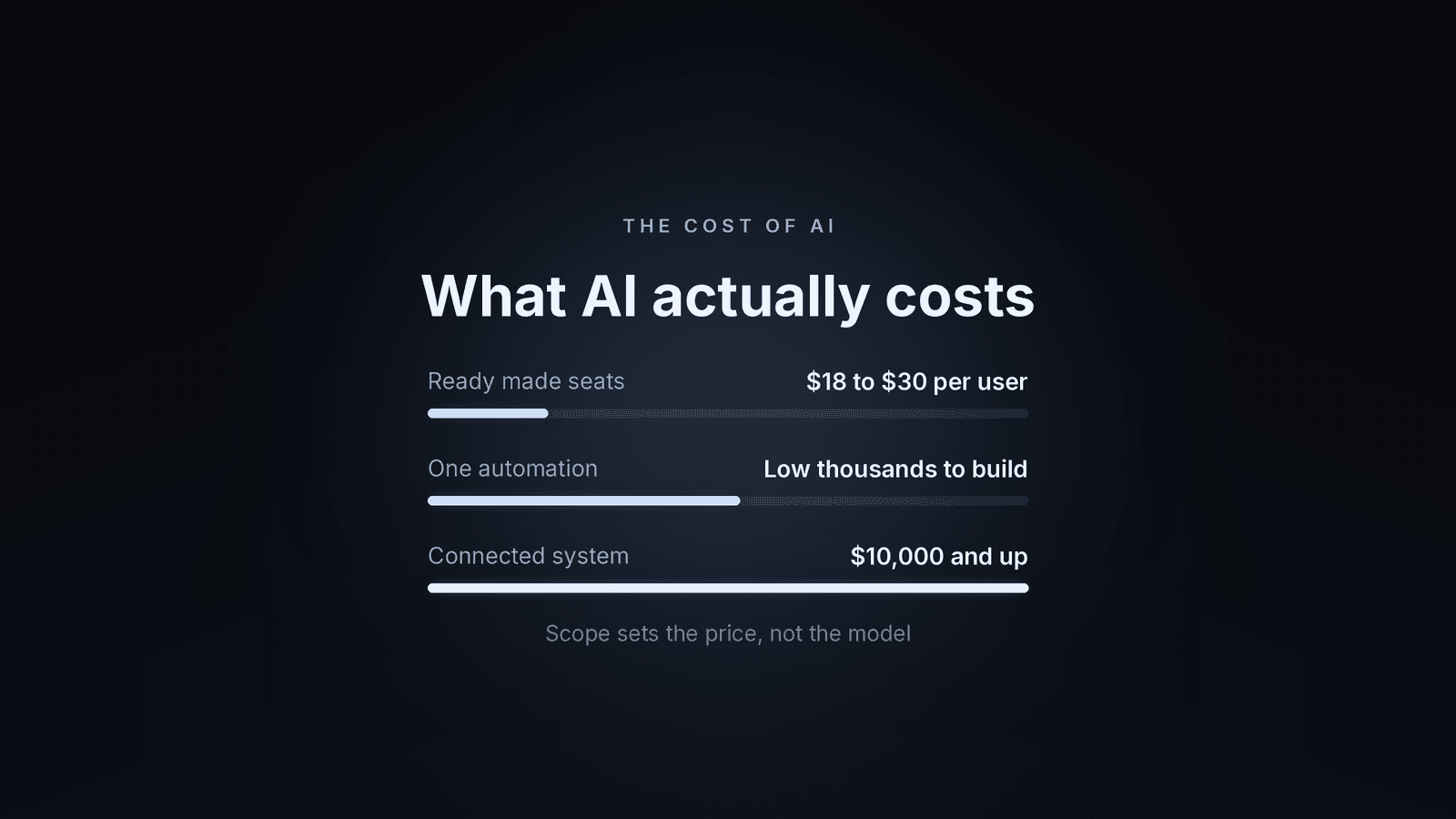
Less than the noise suggests. Ready made assistant seats are priced per person per month, and usage on the underlying models is small change at the volumes most companies generate. The expensive part is never the model. It is connecting AI to your data and your rules, and testing until the output can be trusted.
The mistakes that waste the most money
Automating a process nobody has written down. You end up with a faster version of something broken. Document it first, then automate it.
Expecting it to know things nobody told it. Policies, prices, and exceptions have to be supplied and maintained.
Skipping the supervised period. Two or three weeks of checking output is not wasted time. It is how you find the failure modes before a customer does.
Buying tools instead of solving a task. A subscription is not a result. Pick one repetitive job, measure it before and after, and expand only from what worked.
Believing the demo. Demos run on clean data. Ask any vendor what happens when the document is a blurry photo, the customer asks something off script, or two systems disagree.
How to start this week
Pick the single task your team repeats most that is mostly reading or writing. Write down how it is done today, including the exceptions. Run AI alongside the person doing it for two weeks, with nothing changing for customers. Then count two numbers: how often the output was usable as is, and how much time it saved.
That costs almost nothing and answers the question better than any article, including this one.
The quieter point
AI is not a strategy. It is a capability with a narrow band of things it does extremely well right now. The companies getting value are rarely the ones with the largest ambitions. They are the ones who pointed it at a repetitive job, kept a person in the loop, and measured the result.
Get the next one by email
Reporting, reviews, and guides on AI and automation, sent as they publish. No sequences.