What Is Business Process Automation, in Plain English
A jargon free explanation of what it is, what it is not, and how to recognize a process worth automating.
Business process automation means handing a repetitive, rule based task to software so that it runs the same way every time, without a person doing it by hand. That is the entire concept. Everything else written about it is detail.
The term sounds larger than it is because it is mostly sold by companies with enterprise pricing. In practice, business process automation covers something as small as a confirmation message that sends itself and something as large as an order flowing from a form to a warehouse to an invoice without anyone retyping it.
What counts as a process?
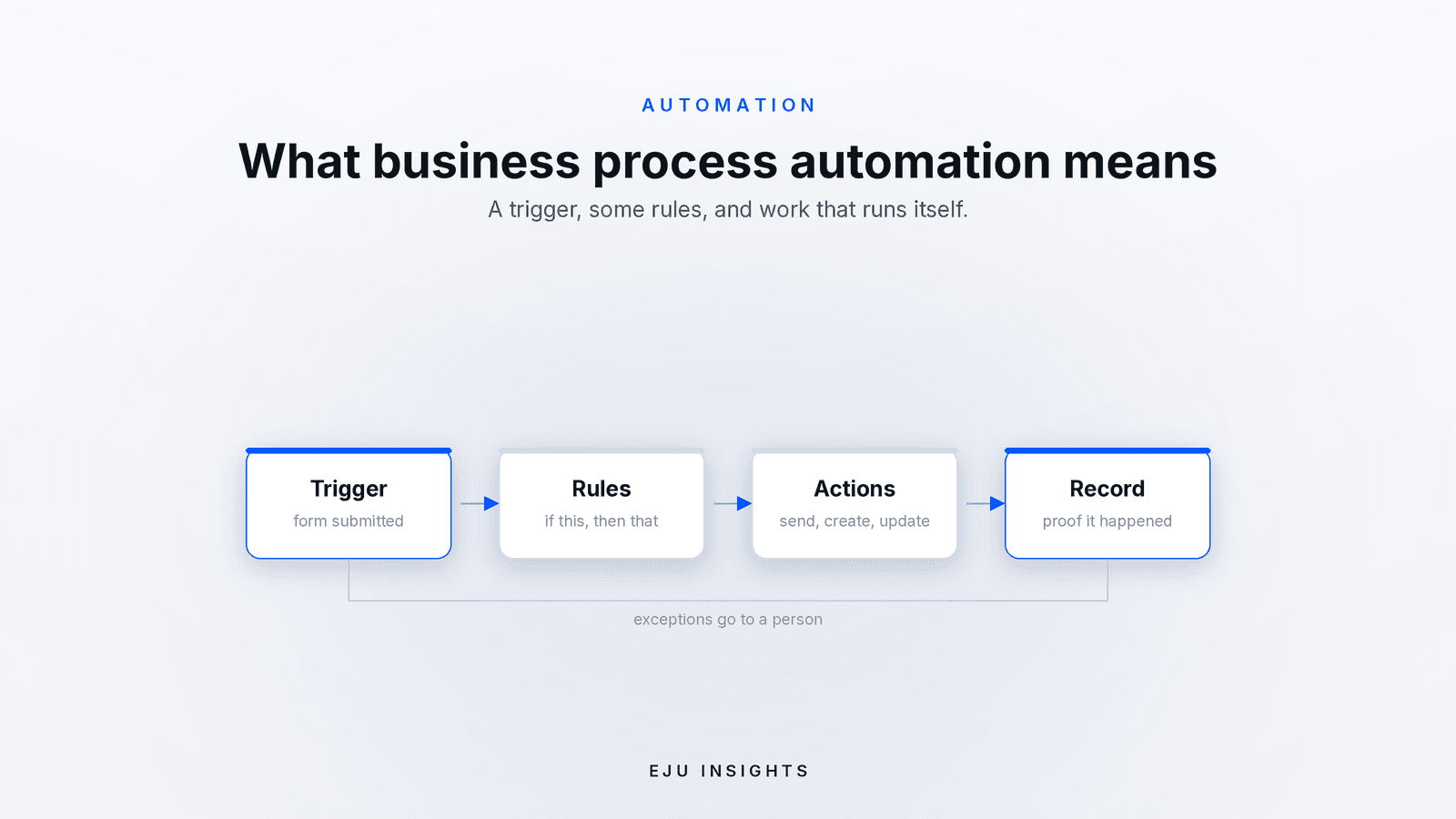
Four parts, and if you can name all four, you have a process rather than a habit.
A trigger. The thing that starts it. A form submitted, an invoice hitting fourteen days, a job marked complete, a file arriving.
Rules. What should happen, including the exceptions. If the order is over a certain value, ask for approval. If the customer is outside the delivery zone, offer collection instead.
Actions. The work itself. Create a record, send a message, update a system, generate a document, notify a person.
A record. Proof it happened, so you can check later and so nobody has to remember.
Automation is simply software performing those four parts. When a business says a process is manual, it means a person is holding all four in their head.
What does it look like in practice?
An enquiry arrives through a form. It is entered into your system, tagged by type, assigned to the right person, and the customer receives a confirmation within seconds.
An invoice passes its due date. A polite reminder goes out at seven days, another at fourteen, and it appears on a list for a human call at twenty one.
A job is marked complete on a phone. The invoice drafts itself with the right customer and price, and the accounts inbox gets a copy.
A supplier sends a delivery note as a photograph. The details are read, matched to the purchase order, and posted into your records, with anything that does not match flagged for a person.
A new employee starts. Accounts are created, the induction pack sends, the equipment request goes to whoever handles it, and their first week is scheduled.
None of that is futuristic. All of it is people typing today.
What business process automation is not
It is not AI. They overlap now, but automation is rules doing predictable work. AI helps with the parts that involve language or messy documents. A great deal of valuable automation contains no AI at all.
It is not replacing your team. In practice it removes the parts of a job nobody wanted: retyping, chasing, remembering, copying between systems.
It is not one big system. Most automation is small and specific. Businesses that go looking for a single platform to automate everything usually spend heavily and change little.
It is not the same as digitizing. Moving a paper form to a screen is digitizing. Automation is what happens after the form is submitted, without anyone touching it.
What makes a process worth automating?
Frequency first. Something done daily or weekly is worth attention. Something done twice a year almost never is, however irritating it feels.
Then predictability. If you can write down what happens as a set of if this, then that instructions that a new hire could follow without asking questions, software can follow them too. If two experienced people do it differently, the process is not ready, and that is a management question rather than a technology one.
Then the cost of being wrong. Missed invoices, double bookings, wrong addresses, and forgotten follow ups all have prices attached. Those prices are usually what justifies the work, not the hours saved.
The three levels, and where most value sits
Task automation. One step, done automatically. A confirmation email, a record created, a reminder sent. Cheap, fast, and where everyone should start.
Process automation. A whole flow from trigger to outcome, across two or three systems, including the exceptions. Most of the value lives here.
Orchestration. Several processes joined across departments, with approvals, audit trails, and reporting. Genuinely useful at scale, and usually the wrong first project.
The mistake we see most often is a business attempting the third while the first is still being done by hand.
What automation cannot fix
A process nobody agreed on. Automating a disputed process locks in the confusion permanently.
Bad data. Software moves what it is given, faster.
A capacity problem. If your team is overwhelmed because there is too much work for the number of people, automation helps at the margins. It is not a substitute for hiring.
Absent ownership. Every automation needs a person who knows it exists, what it does, and what to do when it stops. Unowned automations fail silently, which is the worst kind of failure.
How do you start without a project?
Write down one process exactly as it happens today, exceptions included. That document is worth having even if you automate nothing.
Then pick the single step in it that repeats most and involves no judgement. Automate that one step. Watch it for two weeks. Then take the next step.
Businesses that work this way tend to end up with quiet, reliable systems. Businesses that start by buying a platform tend to end up with a subscription and the same manual work.
The quieter point
The goal is not a business with no people in it. The goal is a business where the predictable work happens on its own, and people spend their attention on the parts that actually need judgement.
Get the next one by email
Reporting, reviews, and guides on AI and automation, sent as they publish. No sequences.